
For years, people believed Google search rankings worked like a scoreboard.
If your business ranked #1 for a keyword, then everyone saw you at #1.
That used to be closer to the truth. Today, it is not.
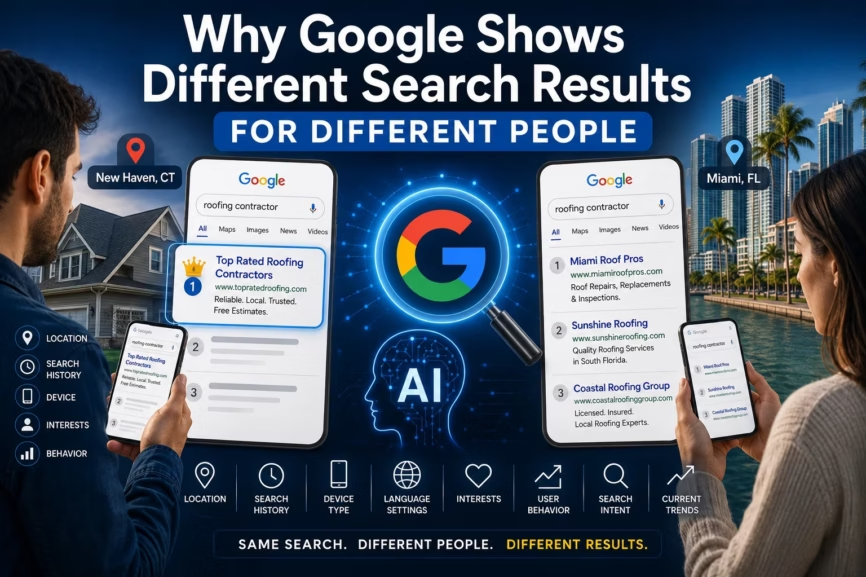
Modern Google search results are highly personalized, context-driven, location-aware, behavior-sensitive, and increasingly powered by artificial intelligence. Two people can search for the exact same phrase and see completely different results.
One person may see your business at the top of page one while another may not see you until page three — or at all.
To understand why this happens, you first need to understand how Google evolved.
The Early Days of Google Search
In the late 1990s and early 2000s, Google changed the internet because of one major innovation: backlinks.
Google’s original algorithm, PageRank, treated links from other websites like votes of confidence. The more websites linking to you, the more authority your website appeared to have.
Before Google, search engines were easy to manipulate because they relied heavily on keyword repetition.
Google improved search by evaluating backlinks, anchor text, domain authority, page structure, and relevance signals.
For a while, SEO became a game of collecting links — and honestly, it worked.
The Era of Gaming Google
As businesses realized rankings meant traffic and revenue, an entire industry emerged around manipulating search results.
People bought backlinks by the thousands and created systems specifically designed to fool Google’s algorithm.
Google Began Thinking Beyond Keywords
Over time, Google shifted from being a simple search engine into something far more sophisticated.
Instead of asking whether a page contained a keyword, Google started asking whether the page was actually the best result for the user.
Search was no longer static. It became dynamic.
Google evolved from a search engine into an AI-driven prediction engine.
Major Google Algorithm Updates That Changed Search
Panda (2011)
Google Panda targeted low-quality content, thin pages, duplicate articles, and content farms. Websites mass-producing weak content saw dramatic ranking drops almost overnight.
Penguin (2012)
Penguin cracked down on spammy backlinks and manipulative link-building tactics. Businesses buying low-quality backlinks were heavily penalized.
Hummingbird (2013)
Hummingbird focused on understanding search intent instead of simply matching keywords. Google began interpreting meaning rather than just phrases.
RankBrain (2015)
RankBrain became one of Google’s first major AI-driven ranking systems. Using machine learning, Google began analyzing user behavior and search patterns more intelligently.
BERT (2019)
BERT helped Google better understand natural human language and conversational search queries. Search became significantly more human-focused.
Helpful Content Update (2022)
Google shifted harder toward rewarding content written for people instead of content created purely to manipulate rankings.
AI-Powered Search & Modern Google
Today, Google increasingly relies on artificial intelligence to summarize information, predict intent, personalize results, and reshape search experiences dynamically in real time.
Why Search Results Are Different for Every User
Today, Google does not show one universal version of search results.
Instead, Google attempts to predict what each individual user is most likely looking for.
Local Search Changed Everything
Local SEO added another layer of complexity.
Google now heavily prioritizes proximity and relevance.
A person searching for a web design company in New Haven may see completely different results than someone searching the same phrase in Hartford, Boston, or Miami.
Google Is Becoming More Like an Intelligent Assistant
Modern Google search behaves less like a directory and more like an intelligent recommendation engine.
Artificial intelligence now plays a major role in understanding questions, interpreting intent, evaluating content quality, predicting user satisfaction, and dynamically re-ranking results.
Why SEO Reporting Tools Often Differ from Reality
SEO reporting tools attempt to remove personalization to provide a more neutral baseline ranking.
Real-world users are not neutral. Their search history, preferences, behavior, and context influence what they see.
What Businesses Should Focus on Instead
Obsessing over one exact keyword position is no longer the best way to measure SEO success.
Modern SEO is about visibility, engagement, trust, and being visible to the right people at the right time.
The Future of Search
AI-generated summaries, conversational search, voice search, and predictive recommendations are rapidly reshaping how people discover businesses online.
Google is no longer simply indexing websites. It is interpreting human behavior.
Modern SEO is no longer about tricking algorithms. It is about creating trustworthy, useful, authoritative content that genuinely helps people.
Factors That Influence Personalized Search Results
- Location
- Device type
- Search history
- Websites previously visited
- Language settings
- User behavior
- Personal interests
- Current trends
- Search intent
- Engagement patterns
A business owner may search for their own company every day. Google notices this behavior and may prioritize familiar websites differently than it would for a first-time visitor.
This is why one person may say, “I see your company everywhere,” while the owner says, “I can barely find my own website.” Both can be correct.